China High-Speed Rail Guide for First-Time Travelers
第一次在中国坐高铁:完整流程与实用中文
Understand the complete journey from choosing a station and booking with a passport to boarding the right carriage and leaving the arrival station.
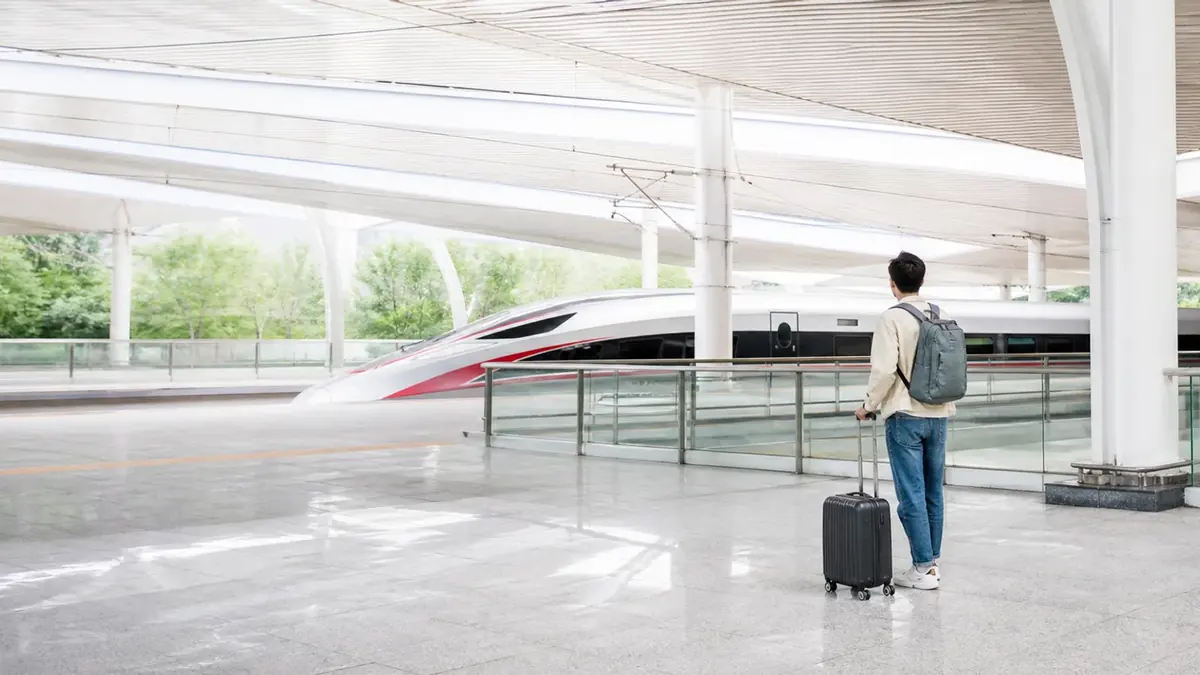
Traveling by high-speed rail in China is straightforward once you understand the order: choose the exact stations, book a real-name ticket, bring the same original travel document, pass station entry and security, find the ticket-check gate, and follow the released platform and carriage information. For most foreign visitors, the passport used for booking is also the document used at the station.
The unfamiliar part is that a large railway station contains several separate checkpoints. Entering the station, passing security, checking the ticket, reaching the platform, and boarding the train are not one action. This guide follows those stages in real order, explains why the document checks exist, and gives you a small set of Chinese questions for the moments when signs are not enough.
The journey at a glance
- 1Choose the exact departure and arrival stations
- 2Book the ticket with the traveler's passport details
- 3Bring that original passport and enter the station
- 4Put all belongings through security
- 5Find the ticket-check gate and watch its opening time
- 6Follow the released platform and carriage markers
- 7Board, find the seat, and monitor arrival information
- 8Exit with the same document and follow onward-transport signs
Already ready to practise? Follow the full Travel by High-Speed Rail in China journey in Chinese.
1. Choose the exact stations and train
Start with station names, not just city names. Beijing, Shanghai, Guangzhou, Chengdu, and many other cities have several passenger railway stations, and they may be far apart. A ticket from Beijing South is not a ticket from Beijing West; Shanghai Hongqiao and Shanghai Station are also different places. Check the full Chinese or English station name on a map before paying, then allow time to reach that specific building.
Next confirm the travel date, departure time, train number, arrival station, and seat class. The train number is the best identifier when several services leave for the same city. Save the booking details where you can reach them without relying on a slow connection, but treat them as trip information rather than a replacement for your passport.
There is no single arrival buffer that fits every station and travel day. Large stations involve walking, document checks, security, and possible queues, while ticket checking stops before departure. On your first trip, arrive early enough to solve a wrong entrance or an unfamiliar manual channel without racing the clock.
- Match the full station name, including words such as South, West, East, North, or Hongqiao.
- Check the date and departure time, especially for trains close to midnight.
- Use the train number to match your booking with station displays.
北京和上海都有好几个火车站,要怎么选?
Běijīng hé Shànghǎi dōu yǒu hǎo jǐ ge huǒchēzhàn, yào zěnme xuǎn?
Beijing and Shanghai both have several railway stations. How should I choose?
Use this pattern when a route search shows several stations for the same city. Replace the city names as needed.
2. Book a real-name ticket with your passport
China Railway uses real-name ticketing. The passenger's identity information is attached to the ticket, so enter the name, passport number, and document details exactly as the booking service requests. China Railway's official English website supports valid foreign passports, and the official 12306 channels provide ticket purchase, change, and refund services. Interfaces and verification steps may change, so follow the current prompts rather than an old screenshot guide.
An e-ticket means the transport record is electronic; it does not mean you can leave the original document behind. China Railway says the valid ID document used to purchase the e-ticket must be shown for station entry and exit and for boarding. An itinerary sheet or reimbursement receipt is not a boarding document. Keep the original passport safe and accessible until you have left the destination station.
The reason for this flow is institutional, not cultural: the railway system links one passenger, one document, and one ticket for identity verification and transport records. If the passport number or name on the booking is wrong, resolve it before travel instead of expecting station staff to treat a screenshot as proof.
身份核验通过了。
Shēnfèn héyàn tōngguò le.
My identity verification has passed.
身份核验 is the identity-verification step connected to real-name booking.
3. Enter the station and pass security
At the station, look first for 进站 (jìnzhàn), meaning station entry. A foreign passport is a valid ticketing document, but it is not one of the documents listed for self-service gate reading in the current China Railway real-name rules. Passengers using other documents, including a foreign passport, use the staffed manual channel for real-name verification and entry. Have the original passport open and ready when staff ask for it.
Station entry is followed by security. China Railway states that all passengers and their carried belongings are subject to security inspection. Put suitcases, backpacks, and loose bags on the luggage scanner and follow staff directions at the walk-through checkpoint. Restrictions on carried items can change and some everyday travel items are quantity-limited, so check the current official list if you are carrying sprays, tools, batteries, or anything unusual.
Do not confuse 进站 with boarding. At this point you are only entering the secure station area. You will still need to find the waiting area, wait for ticket checking, pass the boarding gate, reach the platform, and then get on the train.
我是用护照买的票。
Wǒ shì yòng hùzhào mǎi de piào.
I bought the ticket using my passport.
Say this to staff when you need to clarify which document is linked to the booking.
人工通道在哪边?
Réngōng tōngdào zài nǎbiān?
Which way is the manual channel?
人工通道 is the staffed lane used when the document is checked manually.
4. Find the ticket-check gate and watch the time
After security, you usually enter a waiting area. Match your train number with the station display or ticket details and find its 检票口 (jiǎnpiàokǒu), the gate where the ticket is checked before passengers go to the platform. A label such as 12B is the complete gate identifier; do not stop at 12 if the letter is also shown.
The ticket-check gate is not the station entrance and not the platform. Its screen tells you whether checking has started, is in progress, or has stopped. China Railway warns that ticket checking stops before departure and tells passengers to use the time in station announcements and displays. Because the exact cutoff is operational information for that train and station, rely on the current display rather than memorizing a universal number of minutes.
Wait close enough to see status changes and hear announcements, but keep the lane clear until boarding begins. When ticket checking opens, passport users should follow signs or staff to the manual channel again and present the same original passport.
请问,检票口在哪里?
Qǐngwèn, jiǎnpiàokǒu zài nǎlǐ?
Excuse me, where is the ticket-check gate?
Ask this inside the waiting area after you have matched the correct train number.
几点开始检票?
Jǐ diǎn kāishǐ jiǎnpiào?
What time does ticket checking start?
Use this when the gate is known but its opening time is unclear.
5. Follow the released platform information
Once you pass the ticket-check gate, follow the signs for the platform shown for your train. 站台 (zhàntái) means platform. The route may go downstairs or across a passage, and one sign may point toward a pair of platforms before the path separates. Keep checking the number until you are on the correct side.
Platform information is operational: it can be released near boarding and can change. The current station display, announcement, and staff instruction take priority over an earlier screenshot. If a sign says platforms 6 and 7, confirm which side is 6 before stepping onto the platform instead of following the largest crowd.
Keep moving once you are through the gate, because other passengers are following behind and the walk can take several minutes. This is a station-flow issue rather than a special etiquette rule: the gate controls access to a train whose boarding window is limited.
请问,几号站台?
Qǐngwèn, jǐ hào zhàntái?
Excuse me, which platform is it?
Include the train number if staff need to know which service you mean.
6. Queue for the carriage, then find the seat
Your booking shows a carriage number and a seat number. Find the carriage position first. Platform displays may show the train's direction and tell passengers which colored ground markers apply to that service. Several marker colors can appear because train formations and directions differ; use the color named on the live display, not a color remembered from another trip.
When the train arrives, let passengers getting off leave before you enter. This supports the short dwell time and is also common public-transport courtesy. Board the correct carriage if possible. If you enter a neighboring carriage, stay calm, move through only where permitted, and ask staff which direction leads to your number.
Inside, 车厢 (chēxiāng) is the carriage and 座位 (zuòwèi) is the seat. Read them as separate fields: for example, 11车 means Car 11, while 8A is the seat. Put large luggage only where it can be stored safely, keep valuables with you, and do not block the aisle or doors while arranging bags.
我们的票是十一车厢、八A,应该在哪儿排队?
Wǒmen de piào shì shíyī chēxiāng, bā A, yīnggāi zài nǎr páiduì?
Our tickets say Car 11, seat 8A. Where should we queue?
Use the carriage number to find the correct platform marker before the train arrives.
7. Use onboard services and prepare for arrival
On the train, keep the aisle clear and retain access to your passport and essential belongings. Food options vary by service. A trolley may pass through, and some trains or routes offer ordering through 12306 or a seat QR code, but availability, menus, delivery stations, and payment screens can change. Asking what is available is more reliable than assuming a specific service will appear.
For arrival, compare the carriage display, the station list in your ticket details, and onboard announcements. The scheduled arrival time is a plan, not a live guarantee. A message showing no delay means only that no delay is currently displayed. If you are unsure, ask whether the next stop is your destination rather than waiting until the doors open.
Before the station, gather small belongings and check the seat pocket and charging area. Wait until the train has stopped before taking a heavy suitcase down from an overhead rack. At a terminal station everyone leaves; at an intermediate stop, be ready but do not crowd the door long before arrival.
有点饿了,车上怎么买吃的?
Yǒudiǎn è le, chēshang zěnme mǎi chī de?
I'm a little hungry. How do you buy food on the train?
This asks about the available method without assuming there is a trolley or QR service.
我们是不是快到了?
Wǒmen shì bu shì kuài dào le?
Are we almost there?
Use this with a companion or staff when the display and announcement are unclear.
8. Exit the station and find onward transport
After leaving the train, follow 出站 (chūzhàn), meaning station exit. Keep your original passport available because the real-name e-ticket process also uses the booking document at the destination exit. Follow staff to the manual channel when your document requires manual checking.
Do not arrange a pickup until you know which exit or transport zone you can reach. Large stations often separate metro links, bus areas, regular taxi queues, and ride-hailing pickup points, and the route can continue for several minutes after the exit gate. A driver saying 'north square' or 'Gate 3' is giving a specific meeting point, not simply naming the railway station.
If you want a regular taxi, ask where taxis are boarded. This is clearer than asking where a taxi is, because staff can direct you to the official queue rather than the road outside. Follow the permanent signs and arrows, then recheck the pickup label before you leave the building.
您好,请问出租车在哪里坐?
Nín hǎo, qǐngwèn chūzūchē zài nǎlǐ zuò?
Hello, where can I get a taxi?
坐 makes it clear that you need the taxi boarding point, not the location of one vehicle.
Common misunderstandings on a first journey
A paper printout is not automatically the ticket: an itinerary sheet and a reimbursement receipt cannot replace the valid travel document used for the e-ticket. A station name is not interchangeable with its city: always match the full departure and arrival stations. The 检票口 is not the 站台: first pass the ticket-check gate, then follow the released route to the platform.
Short answers from staff are normal during a routine, time-sensitive task. A reply such as 那边 (over there), 十二B (12B), or 可以了 (that's fine) can be complete in context. You do not need to turn every exchange into a long sentence to be polite; 请问 before a question and 谢谢 after useful help are enough in many situations.
Finally, avoid treating one station visit as a nationwide promise. Gate layouts, manual lanes, platform release times, onboard services, and app labels can vary by station, train, and date. Use this process as your map, then let the current ticket details, official notices, displays, announcements, and staff instructions control the final action.
- E-ticket does not mean passport-free travel.
- City name does not identify the exact railway station.
- Station entry, security, ticket checking, platform access, and boarding are separate stages.
- A scheduled time or missing delay notice is not a guarantee against later changes.
Sources and review date
Published 2026-07-23. Last reviewed 2026-07-23 by Mandarin Scenes editorial team. Station procedures and app interfaces can change; check your ticket details and station notices on the day you travel.